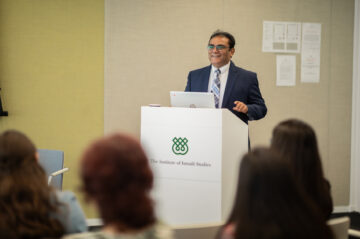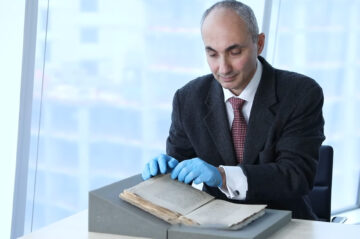

The Ṣaḥīfa al-Sajjādiyya, the prayers of Imam Zayn al-ʿĀbidīn, is often treated as a Twelver text alone. Dr Daryoush Mohammad Poor, Associate Professor at The Institute of Ismaili Studies (IIS), argued that the book belongs to Ismaili history too. He made the case at Salaam Talks, Mahfil Ali, Harrow, on Friday 4 September 2026.
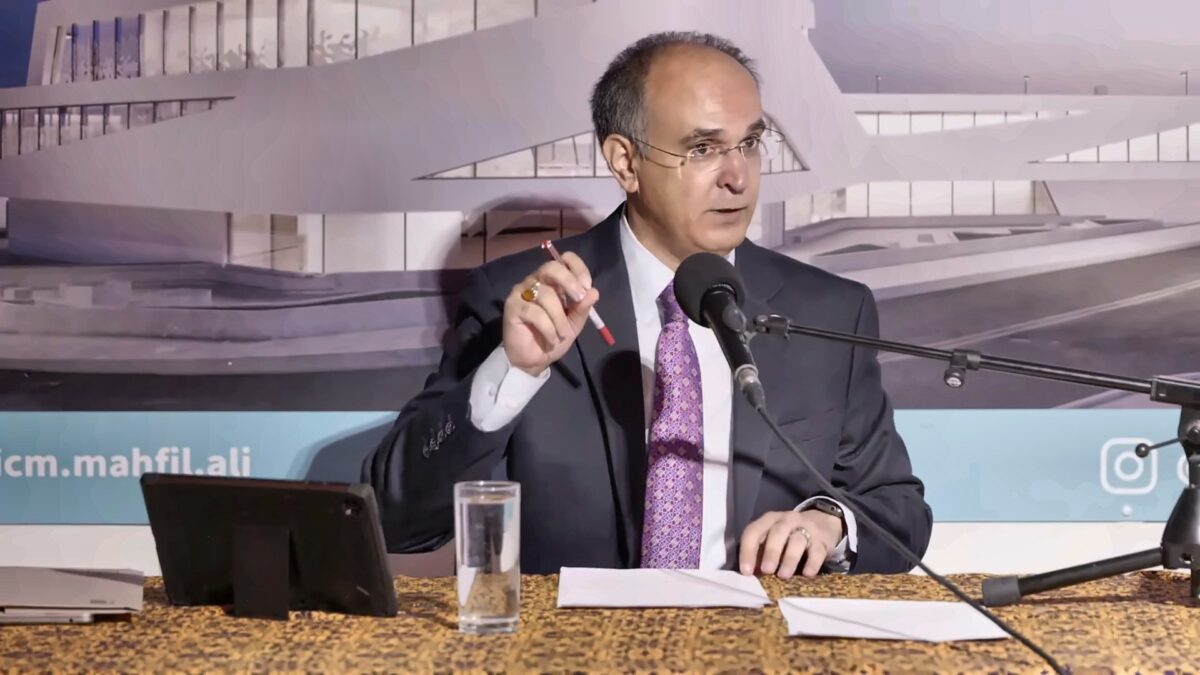
His evidence ran from the book’s opening pages to a Fatimid manuscript from Cairo and two Persian works from Alamūt. The talk then followed the prayers’ ethic of care from Medina to the Ismaili Imamate’s work today.
A book for both branches of the family
The Ṣaḥīfa gathers supplications attributed to Imam ʿAlī b. al-Ḥusayn, known as Zayn al-ʿĀbidīn, the son of Imam Ḥusayn. Shiʿi tradition calls the collection the Psalter of the Family of Muḥammad. Modern scholarship often assumes the book belongs to the Twelver devotional world alone. Dr Mohammad Poor argued that this assumption is incorrect.
His first piece of evidence sits at the front of nearly every printed copy. The opening narrative describes Imam Jaʿfar al-Ṣādiq asking his son Ismāʿīl to bring his copy of the prayers. Placed side by side, the two copies match without a single variation. Ismāʿīl b. Jaʿfar al-Ṣādiq is the figure after whom the Ismailis would later be named.
Dr Mohammad Poor was careful about the limits of this evidence. “The text does nothing to close off an Ismaili reading,” he said. “At the moment it first settles into a fixed shape it makes room for both branches of the family.”
From Fatimid Cairo to Alamūt
The evidence continues in Fatimid Cairo. Al-Muʾayyad fī al-Dīn al-Shīrāzī (d. 1078) served as chief daʿi under the Imam-Caliph al-Mustanṣir (d. 1094). A late Fatimid manuscript of his Dīwān includes a psalm attributed to the Ṣaḥīfa. The same manuscript holds a supplication al-Muʾayyad wrote in the same register. “He was reading the Ṣaḥīfa closely enough to write like it,” Dr Mohammad Poor said.
At Alamūt, two works linked to Naṣīr al-Dīn al-Ṭūsī carry the Ṣaḥīfa into Nizārī Ismaili literature. The first, the Rawḍa-yi taslīm, quotes the prayers in its chapter on the refinement of character. Ṭūsī explains why an Imam prays for forgiveness: to teach believers how to ask. In Dr Mohammad Poor’s words, “The believer learns to pray by overhearing the Imam.”
The second work, the Akhlāq-i Muḥtashamī, gathers sayings under 40 chapters in plain Persian for ordinary believers. Its editor, Dānishpazhūh, marks quotations from the Ṣaḥīfa in 26 chapters. Dr Mohammad Poor’s word-by-word reading finds more, notably in chapter 2 on prophecy and imamate. The Imam’s prayer appears at the climax of each chapter, where its ethics “stops describing and starts asking”.
One detail stands out. In the Alamūt manuscript, psalm 26, the Imam’s prayer for his neighbours and friends, carries an extra clause. The clause asks God to guide those who have strayed from the walāya of “Your proofs over Your creation”. That phrase is a technical Ismaili name for the Imams. Dr Mohammad Poor called this “the exact stitch where the ethics and the imamate are joined”.
The manuscripts also matter for future scholarship. The Akhlāq’s quotations preserve a family of readings with their own cadences. “Whoever one day produces a fully critical edition of the Ṣaḥīfa will need the Ismaili manuscripts to do it properly,” he said.
A shared inheritance
Dr Mohammad Poor traced two linked ideas from the Ṣaḥīfa across languages and centuries. The first is an ethic of care for the weak, the sick, and the stranger. The second is the conviction that a living guide holds this ethic in place. These themes move from Arabic in Medina to Persian at Alamūt. They live on in the gināns of South Asian Ismaili pirs and the qaṣīdas of Nāṣir-i Khusraw.
He heard the same vocabulary in the Ismaili Imamate’s work today on quality of life and care for the vulnerable. “The institutions are modern. The grammar underneath them is thirteen centuries old,” he said.
The Ṣaḥīfa also challenges a common scholarly divide between an esoteric Ismaili Shiʿism and an exoteric Imāmī Shiʿism. “It is a Shiʿi book, full stop,” Dr Mohammad Poor said, “and each branch of the family heard the Imamate in it as it understood the Imamate.” He closed with a line from psalm 47 that both communities share: “O God, You have supported Your religion in every age with an Imam.”
A question-and-answer session followed the talk. Audience members asked about the Ismaili understanding of the Imam and about ritual prayer. Other questions covered the Dawoodi Bohras and tawḥīdThe Oneness of God or belief in Divine Unity, one of the fundamental tenets of Islam. (the oneness of God). The recording includes the full discussion.