
The Institute of Ismaili Studies (IIS) hosted a lecture as part of its Islamic History and Thought Lecture series (IHTLS) examining the contested succession following the death of the Fatimid Imam-caliph al-Mustansir biʾllāh on 29 December 1094. Delivered by Professor Paul Walker and moderated by Dr Fares Gillon, a specialist in Fatimid and Ismaili thought, the session explores one of the most complex and divisive episodes in Ismaili history. The lecture focuses on competing claims to succession, the role of political authority, and the challenges of reconstructing historical truth from fragmented and contested sources.
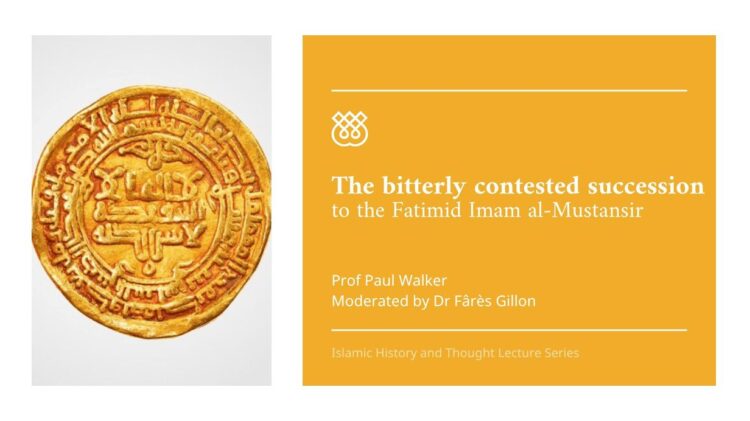
In this lecture, Professor Walker outlines the central dispute between Nizari and Mustaʿli/Tayyibi interpretations of succession. While Nizari IsmailisAdherents of a branch of Shi’i Islam that considers Ismail, the eldest son of the Shi’i Imam Jaʿfar al-Ṣādiq (d. 765), as his successor. maintain that al-Mustansir designated his eldest son Nizar, Mustaʿli traditions hold that the Imam, towards the end of his life, appointed his younger son Abu’l-Qasim Ahmad, who became al-Mustaʿli. Walker critically examines the problem of evidence, challenging earlier historical accounts that assert Nizar’s designation. He revisits reports involving Hasan-i Sabbah and questions both their chronology and their validity as formal acts of designation (nass).
A key contribution of the lecture is the introduction of a neglected Coptic source, the History of the Patriarchs of the Coptic Church, particularly the section on Patriarch Michael IV. Walker presents this as a near-contemporary account suggesting that al-Mustansir designated Abu’l-Qasim Ahmad during his final illness. According to this account, Nizar objected to his brother’s enthronement, claiming prior promises and written proof, but fled before presenting evidence. He later established a rival claim in Alexandria, where he received strong support before being defeated by the vizierA high officer of state, equivalent of a chief minister. al-Afdal and dying in captivity.
Key themes discussed
- The succession crisis of 1094 as a defining moment in Ismaili history
- Competing Nizari and Mustaʿli claims to legitimate succession
- The problem of historical evidence and contested narratives
- The role of Hasan-i Sabbah and questions around formal designation
- The significance of the Coptic source as a near-contemporary account
- Political dynamics in Alexandria and the role of the Fatimid vizierate
- The use of state narratives and propaganda in shaping historical memory
- The enduring complexity of Fatimid succession disputes
In his work, A Short History of the Ismailis, Dr Farhad Daftary notes:
Al-Mustansir had initially designated his eldest surviving son Abu Mansur Nizar (437-88/1045-95) as his successor, following the Shi’i rule of the nass. Abu’l-Qasim Shahanshah, better known by his title of al-Afdal, who a few months earlier had succeeded his father Badr al-Jamali as the all-powerful Fatimid vizier and “commander of the armies”, however, had other plans. Aiming to strengthen his own dictatorial position, al-Afdal favoured the candidacy of Nizar’s much younger half-brother Abu’l-Qasim Ahmad (467-95/1074-1101), who was entirely dependent on him (p. 106).
Dr Daftary bases his assertion of the initial designation of Nizar on the epistle of the Fatimid caliphIn Arabic khalīfa, the head of the Muslim community. See caliphate. al-Amir, a successor of al-Musta‘li, issued in 1122 CE, entitled al-Hidaya al-Amiriyya. In that epistle, which was written to argue against Nizar’s claim to succession, the author admits that Nizar was officially proclaimed the heir-apparent of his father, and that this was communicated to provincial agents of the government. In the introduction to an edition of this epistle, the editor, Asaf A. A. Fyzee, writes:
As is known, Ismailism itself came into existence as an independent sect of Islam in circumstances closely resembling the case of Nizār, and the immediate cause of the split of the Shi‘ite community was exactly the defence of the dogma of the irrevocability of the nass (p. 4).
This belief that a nass made cannot be withdrawn was the basis on which the Ismailis refused to recognise the legality of the idea of a subsequent nass to Musa al-Kazim. Their view was that, even if Isma‘il had pre-deceased his father, the transfer of the Imamat was to Isma‘il’s son, Muhammad, and not to Isma‘il’s younger brother, Musa. The same doctrine led to the NizarisAdherents of a branch of the Ismailis who gave allegiance to Nizar, the eldest son of the Fatimid Imam-caliph al-Mustansir (d. 1094) as his successor. rejecting the alleged death-bed nass made to al-Musta‘li.
The lecture highlights the difficulty of disentangling historical fact from polemic in accounts of the succession crisis. By introducing new source material, Professor Walker adds depth to existing debates while emphasising the limits of certainty. The discussion underscores how questions of authority, legitimacy, and political power shaped the outcome, leaving a legacy that continues to inform interpretations of Ismaili history.