With the promise of the blazing summer sun almost palpably upon many of us, read up on some ways light impacts the study of heritage, ranging from (1) the evolution of mosque lamps, and (2) the ‘daylighting’ of water, to (3) the representation and manifestation of light in a variety of sacred spaces across religious traditions.
1. Walid Ahmad Salah al-Din. The Evolution of the Mosque Lamp Mishkah in Islamic Arts: A New Prospective in Light of a Rare Lamp from the Fatimid Period Preserved in the Museum of Islamic Art (Inventory No. 3901). Research Journal of the Faculty of Tourism and Hotels Mansoura University (13), Jun 2023, pp. 125-185. DOI: https://doi.org/10.21608/mkaf.2023.299785
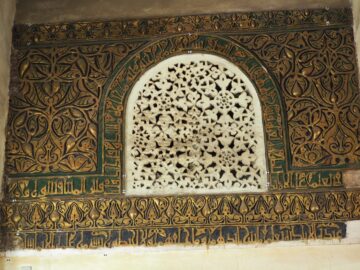
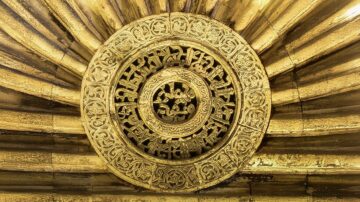
This study traces the evolution of the mosque lamp (mishkah) by examining a small and rare example in the collection of the Museum of Islamic Art in Cairo. Taking both a descriptive and analytic approach, Salah al-Din identifies it as a unique piece dating back to the Fatimid period and traces how such Fatimid lamps inspired and influenced later Ayyubid and Mamluk lamp styles. Each feature of the lamp, including the neck, the handles, and the interior, is painstakingly investigated to determine its origins and later influence. The article also explores the invocation of light and lamps in the Qurʾanic and how they have been used in Islamic architecture over time. The author additionally discusses the possible symbolism of light and lamps in the Shiʿa context of the Fatimid empire. Through an in-depth study of the artistic and practical features of a specific typology of lamp, this article ultimately illustrates the importance of studying material culture and heritage to understand a society.
2. Corinne Segal. Reaching the Light of Day. Orion, Summer 2024.
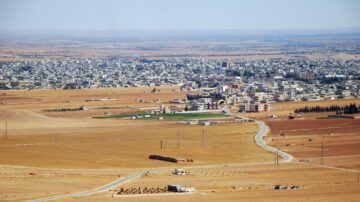
In this fascinating article exploring the relationship of human societies with water, Segal writes about the phenomenon of daylighting, ‘the exhumation of streams from underground and [their] reintroduction … to the surface.’ Long ago, urban landscapes were formed around natural and aboveground pathways of water but these rivers and streams soon came to diverted underground, often buried and encased to make way for construction. This article tells the story of four cities — New York, Baltimore, Auckland, and Istanbul — where people are taking on the challenge of ‘bring[ing] back the rivers of the past, in form and in spirit’, restoring part of the original ecosystem through daylighting. Each story uncovers powerful insights about stewarding our water heritage, how urban planning impacts this heritage and millions of people in different ways, and brings to light and understanding whose cultural landscapes and waterways we choose to value consciously or unconsciously.
3. Barbara A. Weightman. Sacred Landscapes and the Phenomenon of Light. The Geographical Review (86, 1) Jan 1996, pp. 59-71. DOI: https://doi.org/10.2307/215141
In this article, Weightman explores the meaning of light in religious contexts and how that manifests into built landscapes. She considers the diverse expressions of lights in sacred spaces ranging from Stonehenge to Christian churches in the Middle Ages to the great mosques of Cordoba or Isfahan, and the Taj Mahal. The article details four ways in which light and landscapes are intertwined and, therefore, how spaces are beheld and perceived. In the manifestation of light as celestial bodies, as fire, as light and colour, and as an attribute of beings and places, she cites examples from an impressive array of traditions, ranging from ancient Greek, Roman, and Persian, to Indigenous , Buddhism, Hinduism, Christianity, Islam, and Judaism to name just a few, helping us reflect on our own perceptions and experiences of light in the spaces we occupy today.
CRediTs
Zahra Virani (Data Curation, Writing – Original Draft); Fayaz S. Alibhai (Writing – Review & Editing) for Ismaili Heritage, The Institute of Ismaili Studies © 2015-2026.
Ismaili Heritage uses the CRediT author statement.
About
Ismaili Heritage (IH) is a tripartite collaboration between IIS (London), the Aga Khan Trust for Culture (Geneva), and the Department of Jamati Institutions (Lisbon). It aims to document, protect, conserve, and celebrate the built and associated tangible heritage of the global Shia Ismaili Muslims.