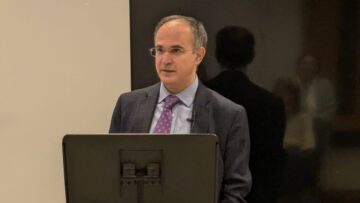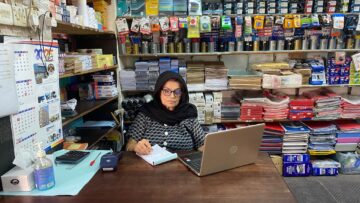

Dr Daryoush Mohammad Poor, an Associate Professor in the Department of Academic Research at The Institute of Ismaili Studies (IIS) visited several cities across the United States to deliver a series of scholarly lectures and Jamati sessions, alongside presenting new research at the Middle East Studies Association (MESA) conference. His trip combined academic contributions, community dialogue, and educator training, reinforcing the Institute’s mission to support the intellectual and spiritual life of the global JamatAssembly or religious congregation; also a term used by the Nizari Ismailis for their individual communities. while advancing Ismaili studies through research and teaching.

Academic presentation at the Middle East Studies Association
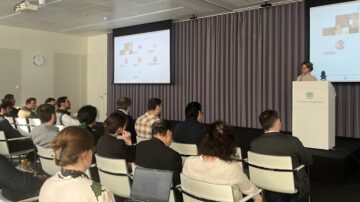
At the annual Middle East Studies Association conference, Dr Mohammad Poor presented a paper examining the identity of Ismailis during the period of concealment following the fall of Alamut. Drawing on the Āthār-i Muḥammadī manuscript, an important text he has studied for several years, he highlighted how Ismaili self-understanding shifted in the centuries between the fall of Alamut (654/1256) and the relocation of the Imamate from Iran to India. This work builds on earlier presentations, including his paper at the Association for the Study of Persianate Societies (ASPS) conference in Tbilisi in 2018, and forms part of his broader, long-term engagement with Ismaili intellectual history and manuscript traditions.
Jamati sessions on ritual practice and community life
The tour began in Sacramento, the capital of California, where Dr Mohammad Poor delivered a session on the etiquette of attending Jamatkhana. He discussed how Jamatkhanas serve as central communal spaces that nurture spiritual reflection, strengthen social bonds, and provide a shared sense of belonging. The session allowed for open dialogue with the Jamat and highlighted how thoughtful engagement with sacred spaces enriches collective life.
In Los Angeles, California, he met with young IsmailisAdherents of a branch of Shi’i Islam that considers Ismail, the eldest son of the Shi’i Imam Jaʿfar al-Ṣādiq (d. 765), as his successor. studying the secondary curriculum and spoke about integrating the Imam’s guidance into daily life. He emphasised intellectual humility, awareness of human limitation, and the need to balance curiosity with ethical responsibility. A further Jamati session explored the diversity of ritual practices across the global Ismaili community, tracing how cultural, linguistic, and historical trajectories have shaped distinct expressions of devotion among South Asian, Central Asian, Middle Eastern, and East African Jamats.
Exploring faith, identity, and devotional practice
In Atlanta, the capital of Georgia, Dr Mohammad Poor delivered several sessions across multiple Jamatkhanas, each tailored to the needs of the local community. One explored the “Imam–murid relationship”, examining how different Muslim communities across time have understood their relationship to spiritual authority. He situated contemporary Ismaili perspectives within broader Islamic intellectual history, including the commonality with Sufi traditions in South Asia and beyond.
Another session centred on spiritual practices, with a particular focus on dhikrLit. ‘the act of reminding’; ‘remembrance’. The Qur’an exhorts individuals to remember God: ‘Oh ye who believe! Remember (udhkurū) God with much remembrance (dhikran kathīran)’ (Q. 33:41). Dhikr designates a… and early-morning devotion. Dr Mohammad Poor discussed how these practices appear across various Muslim traditions and how they contribute to spiritual discipline and reflection. A further session addressed the presence of the Qur’anMuslims believe that the Holy Qur’an contains divine revelations to the Prophet Muhammed received in Mecca and Medina over a period of 23 years in the early 7th century CE. More in the Ismaili Tariqah, countering misconceptions by demonstrating the centrality of Qur’anic verses in the daily rituals of Ismailis and highlighting how Qur’anic ideas resonate through the guidance of the Imamate.

Educator training and bilingual sessions in Houston
In Houston, Texas, shortly after the inauguration of the new Ismaili Centre, Dr Daryoush delivered a session on the spiritual and intellectual dimensions embedded in the daily Dua. This session encouraged the Jamat to reflect on their personal journeys of meaning, particularly in the light of the Imam’s recent visit, which remained vivid in the community’s memory.
At Sugar Land Jamatkhana, he led a specialised session for STEP-trained teachers, educators, and institutional leaders. Here, he provided historical, philosophical, and methodological insights into ritual practice and addressed questions arising from teaching contexts. At Harvest Green Jamatkhana, he returned to the theme of Jamatkhana etiquette and delivered the session bilingually in English and Farsi to ensure accessibility for the Afghan, Tajik, and Iranian members of the Jamat.
Community engagements across the East Coast
In Rochester, New York, Dr Mohammad Poor engaged with Afghan and non-Farsi-speaking Jamats in a session exploring ritual diversity and the arkān (pillars of faith), fostering a lively discussion with younger attendees who raised questions about the meaning and development of various devotional practices.
In Richmond, he presented a session on the spiritual and intellectual journey expressed through the Dua, continuing themes from earlier stops.
In New York, his programme combined academic and Jamati engagements. He delivered a scholarly lecture at Columbia University, hosted by the Middle East Institute, and later held a Jamati session in Manhattan (also attended by members from the Brooklyn Jamatkhana). The session, also attended by Tajik and Farsi-speaking members of the Jamat, focused again on the spiritual dimensions of daily devotion.
His final stop was in Washington, DC, the capital of the United States of America, where he concluded with a session on the intellectual and spiritual contours of the Dua.
Public lectures at Duke University and Columbia University
Outside the Jamati context, Dr Mohammad Poor delivered two academic lectures on his recent publication in political philosophy. At Duke University, he addressed an audience primarily composed of undergraduate students, who posed nuanced questions and demonstrated strong interest in the subject matter.
At Columbia University, he presented to graduate students and scholars, contributing to discussions on the intersections of Islamic thought, philosophy, and political theory. These sessions reflected the longstanding commitment of IIS to the academic study of Islam and to sharing its scholarship with broader audiences

Advancing IIS’s mission through community learning
Reflecting on the visit, Dr Mohammad Poor emphasised the importance of engaging with the Jamat, particularly younger generations, and responding to their questions with clarity and intellectual openness, and in an accessible manner. He highlighted the need to balance faith and intellect, an ethos central to The Institute’s work and the importance of delivering scholarly ideas in language that is accessible without compromising rigour, or our institutional mandate.
He also noted that Jamati engagements offer critical opportunities to update teachers, STEP-trained educators, waezeen, and institutional leaders with current research and approaches. These interactions help build capacity within local institutions and enable communities to benefit from the latest scholarship in Ismaili and broader Islamic studies.
Forthcoming publications
During his visit, Dr Mohammad Poor shared updates on his major ongoing research projects. These include a critical Farsi edition and complete English translation of al-Milal wa al-Niḥal, a significant work by al-Shahrastani (d. 1153 CE). Dr Mohammad Poor’s work on the Farsi translation of the Arabic original, is based on an important Ismaili manuscript tradition preserved from the AlamutFortress of the Nizari Ismailis in northern Iran, which fell to the Mongols in 654 AH/1256 CE. period. The publication will include a facsimile edition, detailed annotations, and a substantial technical introduction synthesising several years of conference presentations and teaching.
He is also developing a revised version of his earlier book Authority without Territory, incorporating new chapters, interviews, and contemporary analysis following the establishment of the Seat of the Imamate in Lisbon. The updated volume will offer an expanded framework for understanding the operation of the Ismaili Imamate in the modern world.
Dr Mohammad Poor’s United States visit demonstrates the Institute’s commitment to combining academic excellence with meaningful community engagement. His sessions, lectures, and discussions strengthened connections with Jamats across the country, enriched public understanding of Ismaili thought, history and practice, and advanced the IIS mission to promote knowledge, reflection, and dialogue within the global community.