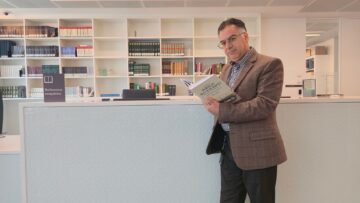
On 9 April 2026, Hindustani classical musician and scholar Dr Budhaditya Bhattacharyya presented his research on the melodicities of the Kalām-i Mawlā (a poetic manual of ethics) at the 2026 Annual Conference of the British Forum for Ethnomusicology. By integrating live musical demonstrations on voice and the swarmandal (a traditional Indian plucked box zither), the research had a wider resonance for ethnomusicologists working in a range of sacred and devotional traditions, especially Islamic soundworlds. Dr Bhattacharyya has been associated with the South Asian Studies Unit at IIS as a research consultant since 2022.
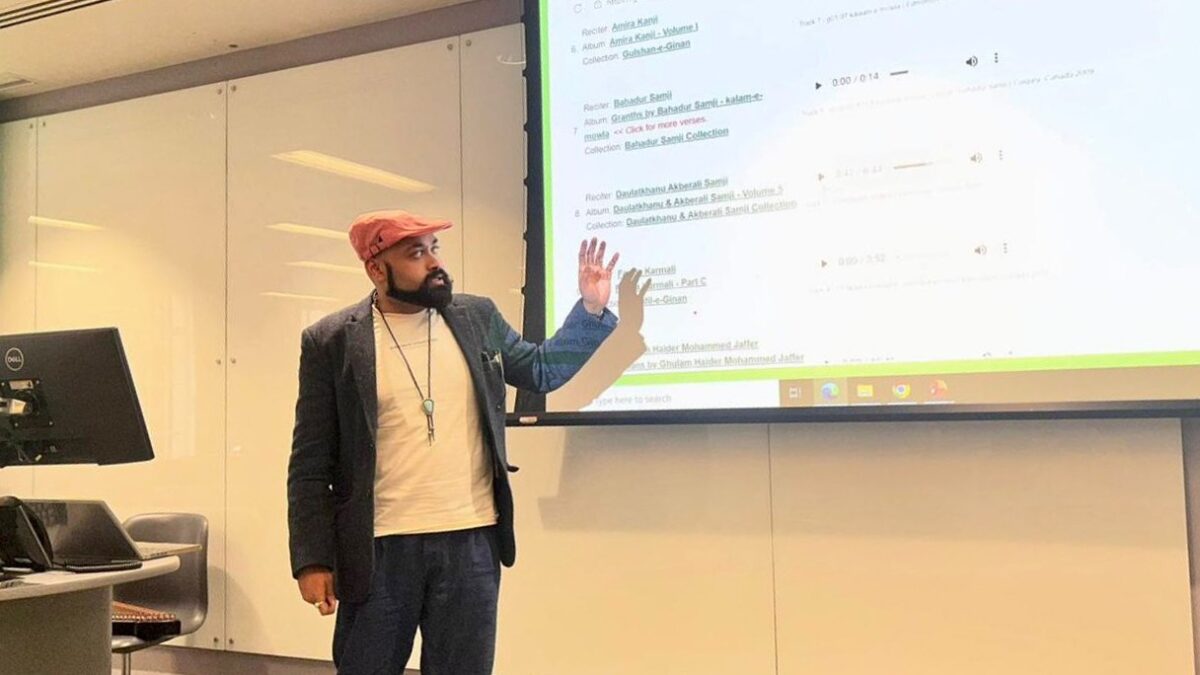
Featured in a session on Sufism and recitation, Dr Bhattacharyya described how IsmailisAdherents of a branch of Shi’i Islam that considers Ismail, the eldest son of the Shi’i Imam Jaʿfar al-Ṣādiq (d. 765), as his successor. transmit their vocalisations of the Kalām-i Mawlā , from generation to generation, during prayers and ceremonies. He also noted how each performance of the Kalām-i Mawlā offers room for improvisation, allowing the text to acquire a sonic ‘living’ quality. Amongst Satpanth Ismailis, the term in common circulation to describe these melismas is rāga.
Rethinking rāga through Ismaili liturgical practice
Moving away from canonical understandings of rāgas as modes with characteristic ascending and descending phrases, scholars have increasingly called for an attunement to regional rāgas. Drawing upon interviews, recordings, embodied rāga knowledge and musicological sources, Dr Bhattacharya’s research attempts to showcase underheard interpretations of rāgas and Ismaili liturgical composition. By noting how the performativity of the Kalām-i Mawlā is imbued with a sense of historical purpose, it also queries how an ethnomusicology of the present might audibilise traces of the past.