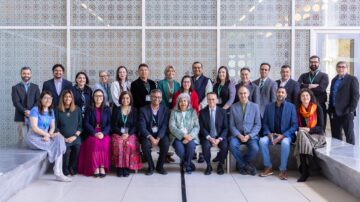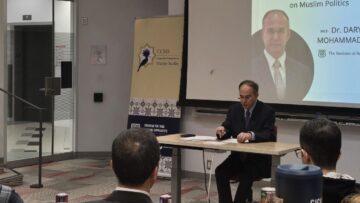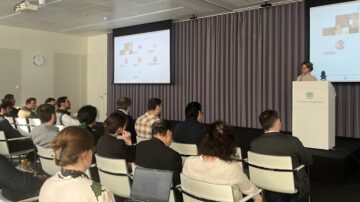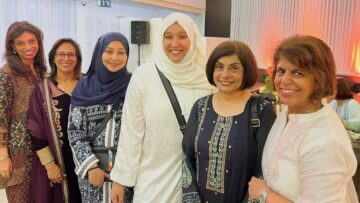

On the evening of 8 March 2026, Alyth synagogue opened its doors for the thirteenth consecutive year to host an interfaith iftar, bringing together members of the Jewish and Muslim communities in a spirit of friendship, hope, and shared humanity. This year’s gathering, themed “Finding Light in the Darkness,” resonated deeply with guests navigating a world marked by rising tensions and polarisation. Rabbi Colin Eimer and Dr Daryoush Mohammad Poor delivered reflections that wove together insights from their respective traditions, offering pathways toward understanding and resilience.

Thirteen years of Jewish–Muslim friendship
In welcoming guests, Dr Mohammad Poor reflected on the significance of the milestone. “Thirteen years of coming together to talk, to study, and to eat—that is already a kind of light in the world,” he observed. For him, the friendships cultivated through these gatherings represent not a by-product of the evening but its “deepest purpose.”
The theme proved timely. Both speakers acknowledged the challenges facing their communities: rising Islamophobia and antisemitism, images of conflict that “wound us daily,” and the internal struggles that arise when fear hardens into suspicion or grief into bitterness.
Becoming “Little Lamps for One Another”
Drawing on the Qur’an’s luminous imagery—“God is the Light of the heavens and the earth”—Dr Mohammad Poor invited participants to consider themselves as “little niches for light.” He recalled how the Qur’anMuslims believe that the Holy Qur’an contains divine revelations to the Prophet Muhammed received in Mecca and Medina over a period of 23 years in the early 7th century CE. More depicts divine light dwelling within a niche containing a lamp, the lamp enclosed in glass shining like a star. “Divine light does not just shine somewhere out there,” he explained. “It needs niches and lamps—places where it can be received, reflected, protected.”
This image found resonance in Rabbi Eimer’s reflections on Jewish mystical tradition, where sparks of divine light became trapped in the material world at the moment of creation. “Our task is to find those shards and release them,” he said, “letting divine light flood the world.”

Choosing Life: A Call from Two Traditions
Rabbi Eimer introduced the thought of Miguel de Unamuno, the Spanish philosopher who, in 1936, stood against a Francoist general’s cry of “Long live death!” with a principled defence of life and reason. Drawing on psychoanalyst Erich Fromm’s concepts of “biophile” (lover of life) and “necrophile” (lover of death), Rabbi Eimer framed the fundamental human choice: “See, I put before you today life and death, good and evil, blessing and curse—therefore choose life.”
The Hebrew phrase u’va’charta ba’chayyim, he noted, means not simply to choose life but to “choose into life”—an active, engaged commitment rather than passive observation.
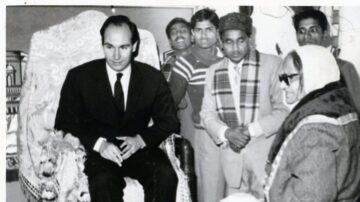
Dr Mohammad Poor echoed this call through the lens of hope. Citing His late Highness Prince Karim Aga Khan, the 49th Imam of the Shi’i Ismaili Muslims, he described hope as “the trampoline of progress—a force that pushes us up even when gravity seems to pull everything down.” Hope, he emphasised, is not naive optimism but a discipline: “the decision, again and again, not to surrender to despair.”
The Power of Continued Meeting
Both speakers emphasised that light emerges through sustained relationship. Dr Mohammad Poor quoted the Persian poet Rumi: “The lamps are different, but the Light is the same.” He reflected that Muslims and Jews may hold different lamps “different rituals, different sacred languages, different historical memories” but the light calling both communities to compassion, justice, and mercy “is of one source.”
The evening concluded with a practical invitation: before leaving, each guest was encouraged to seek out someone from the other community and ask a simple question “How has this last year felt for you?” – and then listen, not to reply, but to understand.
As Dr Mohammad Poor noted, this Iftar represents “a small, stubborn piece of evidence against the story that Jews and Muslims must be enemies.” In an era of division, Alyth’s annual gathering demonstrates that choosing life, friendship, and hope remains possible—one lamp at a time.