
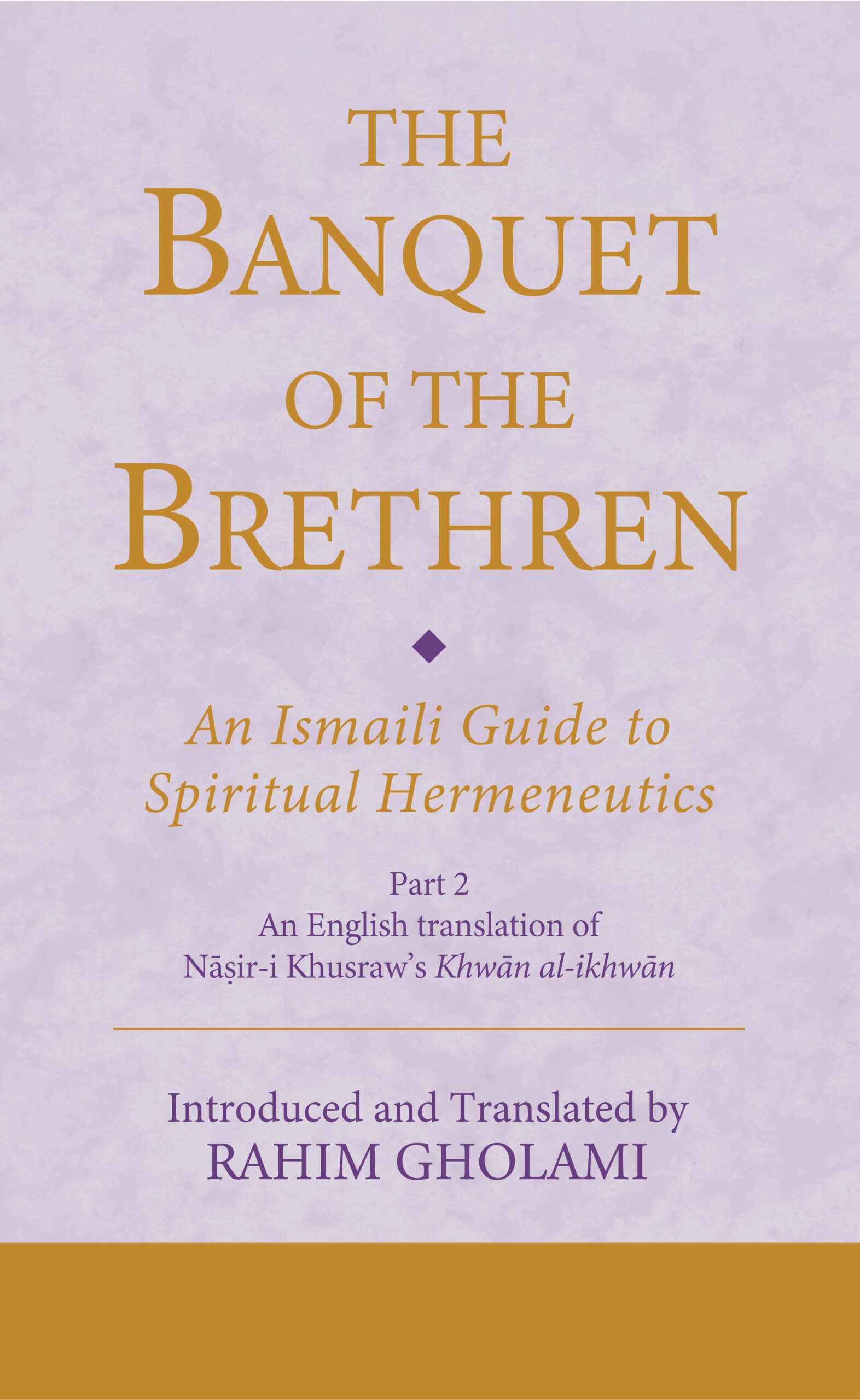
Forthcoming November 2026
The Ismaili dāʿīLit. ‘summoner,’ a term for missionary amongst various Muslim communities, especially used among the Ismailis before and during the Fatimid period as well as in the Alamut period of Ismaili… (missionary) and poet Nāṣir-i Khusraw (d. after 1070) wrote Khwān al-ikhwān (The Banquet of the Brethren) when he was living in his remote mountain refuge of Yumgan in Badakhshān. This work includes a précis of ideas found in the Kitāb al-Yanābīʿ (al-ḥikma) (The Wellsprings of Wisdom), written by the earlier dāʿī Abū Yaʿqūb al-Sijistānī (d. after 971). Nāṣir-i Khusraw recast these ideas in Persian and then expanded them into 100 chapters (or ‘courses’ of a banquet). The text presents a sequence of dynamic arguments for divine unicity (tawḥīdThe Oneness of God or belief in Divine Unity, one of the fundamental tenets of Islam.), while also asserting the authority of the Prophet Muhammad, his legatee and son-in-law ʿAlī b. Abī ṬālibCousin of the Prophet Muhammad and his son-in-law by marriage to his daughter Fatima; the first Shi‘i Imam and fourth caliph (d. 661)., and the subsequent Imams from the line of the Prophet’s descendant Ismāʿīl b. Jaʿfar al-Ṣādiq.
Khwān al-ikhwān stands as a significant work in Ismaili theology and philosophy, exemplifying the central role of taʾwīlThe elucidation of the inner or esoteric meaning, bāṭin , from the literal wording or apparent meaning of a text, ritual or religious prescription. (esoteric interpretation). It also reflects the learning of the age, including the conception of a geocentric cosmos, Aristotelian physics, and Neoplatonic philosophy, all of which profoundly influenced the Ismaili dāʿīs in Iran.
This first English translation of Khwān al-ikhwān, derived from the Persian critical edition presented in Part 1, is accompanied by detailed annotation and an introduction which situates this important text in the context of Nāṣir-i Khusraw’s other works and Abū Yaʿqūb al-Sijistānī’s Kitāb al-Yanābīʿ.
Table of Figures
Acknowledgements
Abbreviations
Introduction to the English translation
English translation of Khwān al-ikhwān
Select Bibliography
Index of Qurʾanic Citations
Index of Ḥadīth Citations
Index of Biblical Citations
General Index
Rahim Gholami is a Research Associate at The Institute of Ismaili Studies. He received his PhD in Arab and Islamic Studies from the University of Exeter, UK, in 2021. His research interests include Shiʿi esoterism and poetics, Ismaili intellectual traditions, and esoteric hermeneutics and literature.