Scholars from The Institute of Ismaili Studies (IIS) contributed to debates at the cutting edge of theory and methods in the study of religion at the field’s largest international congress of 2026. Organised under the theme Religions 360°, the congress in Bucharest, Romania, brought together the European Association for the Study of Religions (EASR) and the International Association for the History of Religions (IAHR) over six days from 20 to 25 September 2026.
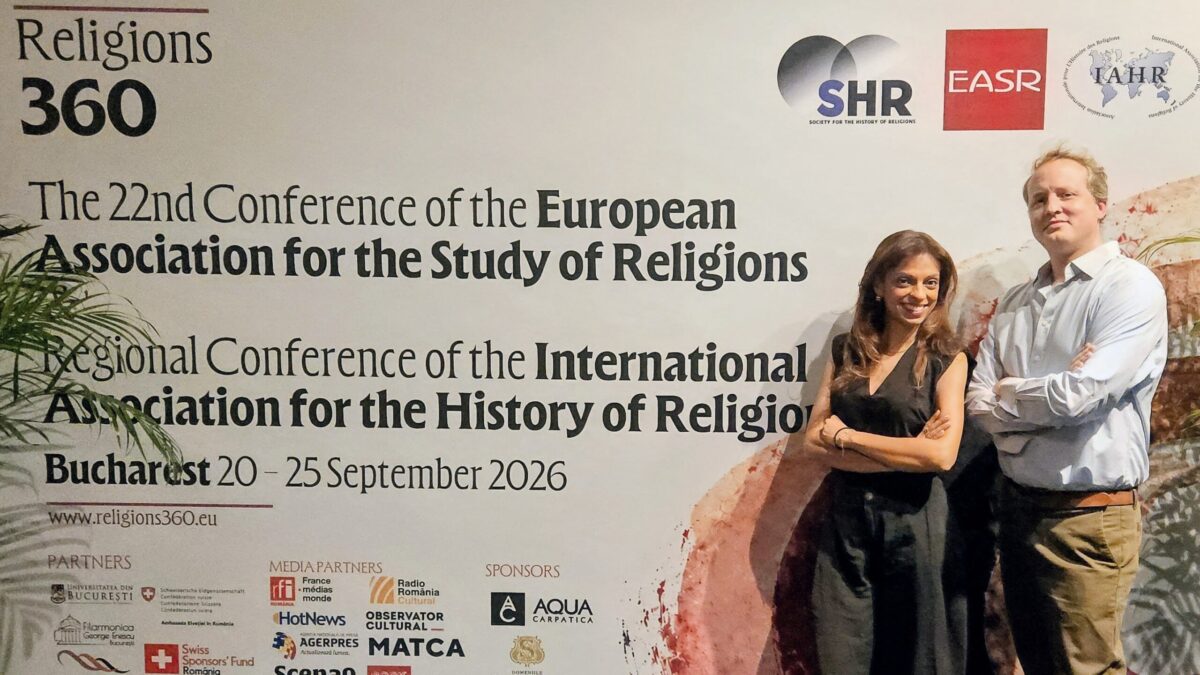
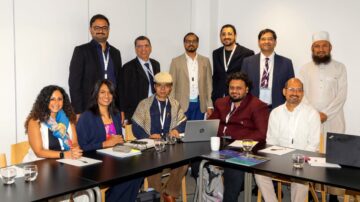
IIS was represented by Dr Fatima Dhanani and Dr Alex Henley, both of whom spoke on prominent panels on new critical and decolonial directions in the study of religion. Both panels also featured Professor Aaron W. Hughes (University of Rochester and Stockholm University), a leading authority on theory and method in religious studies who has been actively collaborating with IIS on an upcoming history of Ismaili Muslims in Canada.
Decolonising the Lebanese Sectarian Framework
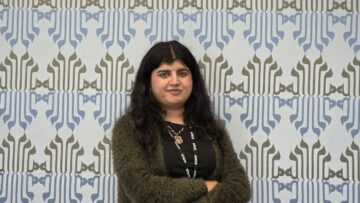
Dr FatimaDaughter of the Prophet Muhammad and his first wife, Khadīja bint Khuwaylid. Also wife of ʿAlī b. Abī Ṭālib and mother of al-Ḥasan and al-Ḥusayn. Dhanani presented her paper, ‘Decolonising the Lebanese Sectarian Framework through Epistemic Negotiation’, on a panel entitled Decolonisation and the Study of Religion. The session brought together four international specialists, including Aaron W. Hughes, Jørn Borup (Aarhus University) and Martin Thomas Riexinger (Aarhus University), to critically scrutinise the theoretical underpinnings and analytical applications of decolonial concepts across Islamic studies and the history of religions in various contexts.
Drawing upon Aníbal Quijano’s framework of the ‘coloniality of power’ and Walter Mignolo’s notion of ‘epistemic disobedience’, Dr Dhanani examined the institutionalisation and governance of ‘religion’ within Lebanon’s system of legal pluralism. She challenged conventional analyses that either treat sectarian frameworks purely as static colonial impositions or take the neutrality of the religion/secular divide for granted. Instead, Dr Dhanani highlighted how sectarian governance operates as an ongoing process of ‘religion-making’ embedded within modern nation-statecraft.
Engaging with the scholarship of Abdulkader Tayob, Dr Dhanani demonstrated how local Lebanese actors actively contest, redefine and renegotiate these legal and sectarian structures through family law, kinship networks and institutional practices. Rather than mere passive subjects of colonial administrative legacies, these actors exercise sustained epistemic negotiation and intellectual resistance.
Dr Dhanani concluded by proposing that when legal pluralism is anchored in genuinely pluralist and egalitarian values, it can transform from a tool of state management into an indigenous framework for recognising lived human diversity. Pointing to late nineteenth- and early twentieth-century reformist thinkers such as Muḥammad ʿAbduh, who mobilised the category of religion to envision alternative social and political orders, her paper argued that grounded pluralism provides a generative path forward for decolonial scholarship and legal practice.
Critical Religion: Exploring the Revolution
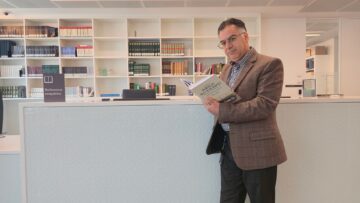
Dr Henley organised and chaired a roundtable discussion entitled Critical Religion: Exploring the Revolution. Participants explored and debated the ‘veritable scientific revolution’ sweeping religious studies departments, as it was diagnosed by French scholar Daniel Dubuission. This revolution – sometimes called ‘Critical Religion’ – is a shift away from treating ‘religion’ as an innate, self-evident phenomenon to analysing it as an invented, modern classificatory technology deeply entwined with statecraft, law and power.
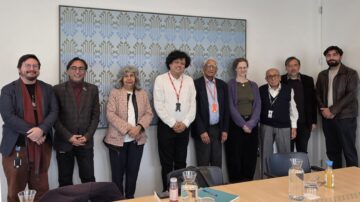
A panel of six speakers framed the discussion by building on Dr Henley’s recent edited book, A Practical Guide to Critical Religion (Bloomsbury 2026). Leveraging the authors’ efforts to survey the current state of Critical Religion, each panellist articulated what they see as the field’s most revolutionary and most promising new directions. The panel featured a mix of contributors to and readers of the book, representing a variety of specialisations and contexts: Aaron W. Hughes, Naomi Goldenberg (University of Ottawa), Peggy Schmeiser (University of Saskatchewan), Teemu Taira (University of Helsinki) and David O’Reilly (University of Waterloo).
Opening the session, Dr Henley explained why he uses the term ‘Critical Religion’ as a succinct, vital shorthand for the kind of revolutionary scholarship that critiques the categories of religion, the secular, and their associated conceptual binaries. Paralleling developments in critical race theory and critical gender studies that have made waves across academia and beyond, he emphasised that a Critical Religion approach is not merely an abstract theoretical exercise but an exportable analytical lens that opens up fresh avenues for empirical research and socially -conscious thinking.
The subsequent dialogue engaged with audience questions concerning the application of critical approaches outside Euro-American contexts, historical source analysis, and the place of theological and personal commitments. A lively debate brought out many of the concerns and tensions that are animating the discipline, helping us to map out where future work is needed and where new opportunities are opening up.
Advancing Critical Approaches to Religion and Society
The presence of IIS faculty and collaborators across both of these key panels illustrated IIS’ engagement with cutting-edge theoretical issues in the humanities and social sciences. By examining how categories of religion and secularity are produced or resisted, both in historical Muslim societies and contemporary pluralist contexts, IIS scholars continue to foster dialogue between Islamic studies and the wider academic study of religion.