
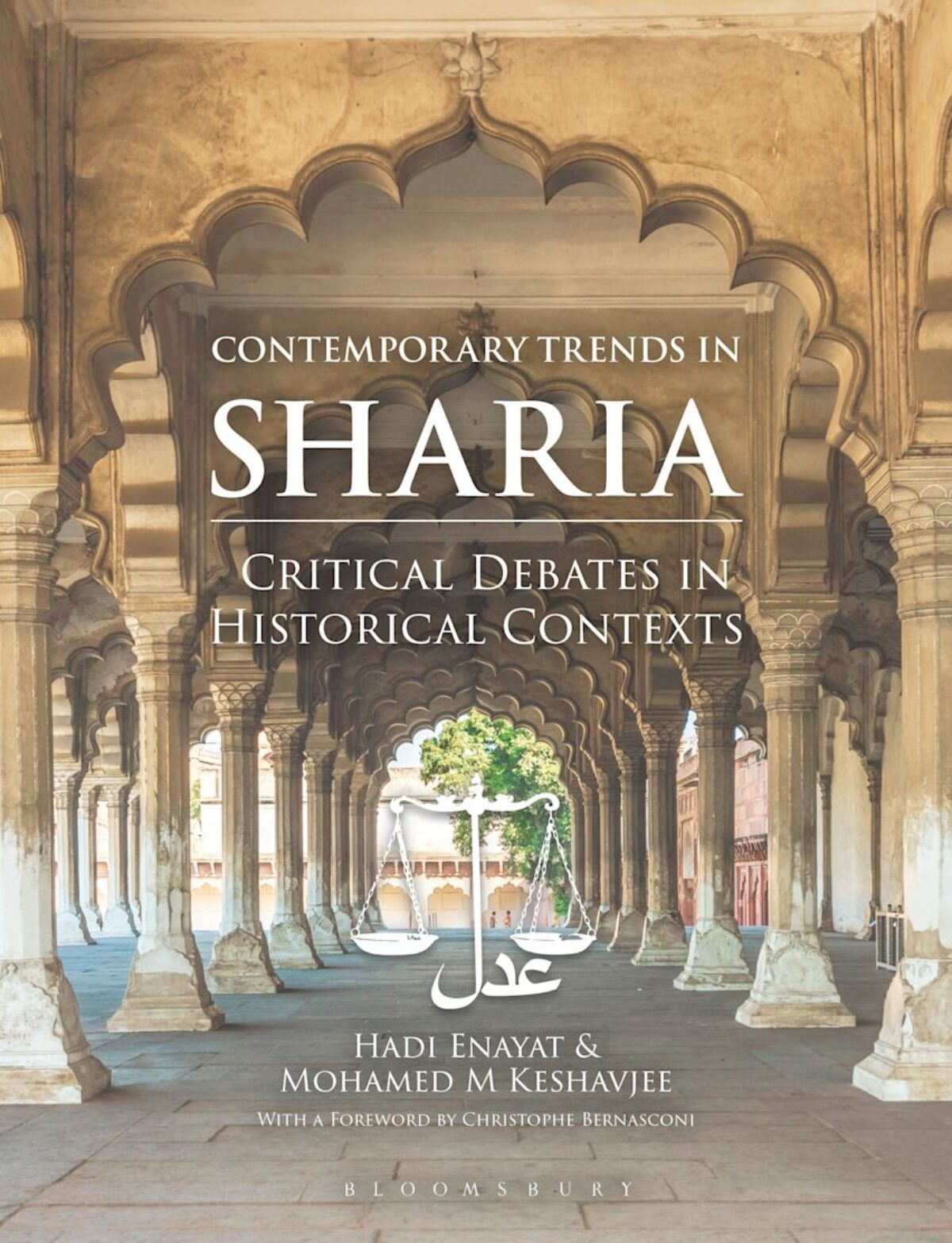
Books on sharia generally tend to focus more on jurisprudence and legal theory, setting out the diverse rules of various Muslim schools of law on a particular issue and the predicted outcome. Aside from the work of a few scholars like Wael Hallaq, Brinkley Messick, Marion Katz and Talal Asad, rarely does one encounter a study of sharia that situates it squarely in its historical, sociological, cultural, and political contexts. Contemporary Trends in Sharia: Critical Debates in Historical Contexts – co-authored by political sociologist Dr Hadi Enayat and English-trained Barrister-mediator Dr Mohamed M. Keshavjee, with a foreword by Dr Christophe Bernasconi, Secretary General of The Hague Conference on Private International Law – opens up a fresh space for reflection. It foregrounds the purposes of law – an approach underexplored in Muslim juridical thought – while probing sharia’s limits and contradictions, as well as its potential to meet the evolving needs of Muslim communities as the 21st century progresses.
This wider lens matters because one of the most consequential shifts in late 20th-century global politics was the public resurgence of religion – an upsurge that unsettled assumptions that modernisation would naturally produce secularisation. From conservative Christianity in the United States to the electoral rise of the Bharatiya Janata Party in India, faith re-entered political life. Nowhere was this more visible than in the diverse Islamic revival movements, which pressed nation states to codify and enforce sharia. For many ordinary believers, sharia signified justice or good governance; others championed a programmatic Islamic state. In the 1980s and 1990s these impulses animated mainly peaceful Islamist campaigns – shaped by the Muslim Brotherhood and the 1979 Iranian Revolution – to make sharia a constitutional benchmark. However, in the 2000s, armed groups in countries such as Afghanistan, Iraq, Somalia, and Syria sought the same end through violence.
What sharia means – and what it should mean – remains contested. The present crisis of Islamic authority is bound up, inter alia, with disagreements over its sources, interpretive methods, and institutions. Key protagonists in this debate include thinkers variously described as modernist, reformist, progressive, or neo-traditionalist, who critique both rigid scripturalism and unreflective borrowings from the West, and who seek a distinctively Muslim modernity through critical engagement with tradition and contemporary knowledge.
About the book
Contemporary Trends in Sharia focuses on these issues. First, it offers a critical introduction to modernist and progressive (and, where relevant, neo-traditionalist) approaches to sharia, covering constitutional design, human rights, gender justice, bioethics, religious freedom, criminal justice, economic life, finance, and property. The book asks: Must sharia take the form of a single state code? Can it be reconciled with constitutionalism and human rights? What are the ramifications for women, non-Muslims, and so-called heterodox Muslims? Can sharia resources underpin a more ethical political economy beyond neoliberalism? In addressing these questions, the book reconstructs the genealogies of reformist legal thought and shows how they have been institutionalised in majority- and minority-Muslim contexts.
Key themes
Second, the book situates reform agendas historically and politically, assessing their reception among Muslim publics and rival currents of Islamic thought. Why are some efforts denounced as Eurocentric or dangerous? How has the wider crisis of liberalism shaped attempts to ‘vernacularise’ liberal concepts in Islamic terms? More broadly, what can legal reform realistically accomplish in the struggles of Muslims for justice and emancipation – and where do the limits of law really lie?
Taken together, these strands make this ground-breaking book both a map and a set of instruments: Contemporary Trends in Sharia shows where debates over sharia have come from and equips readers to navigate where such debates are going. The result is a rigorously sourced, accessible guide for scholars, practitioners, and engaged readers who want to think beyond slogans – towards workable, principled futures for Islamic law in a plural and increasingly pluralistic world at a time of major global transformations.
Contemporary Trends in Sharia: Critical Debates in Historical Contexts is to be published in summer 2026 by Bloomsbury Publishing as part of the publications programme of The Institute of Ismaili Studies, London.
Contact person: Mr Susheel Gokarakonda, Senior Marketing and Communications Manager: communications@iis.ac.uk
The book has already received some plaudits, including:
‘A timely and deeply engaging exploration… A must-read for understanding the dynamism of modern Islamic thought.’
Masooda Bano, Professor of Development Studies and Senior Golding Fellow, Brasenose College, University of Oxford
‘A sweeping and timely exploration of how Muslims across the globe grapple with aligning faith and modern life
… an essential resource for understanding how sharia continues to evolve in response to contemporary realities. Vital reading.’
Ebrahim Moosa, Mirza Family Professor in Islamic Thought & Muslim Societies, Keough School of Global Affairs, University of Notre Dame, USA.
‘Contemporary Trends in Sharia offers a rigorous and accessible analysis of today’s key debates on Islamic law
… It is an authoritative contribution to the study of Islamic law, reform, and modernity.’
Abdullah Saeed, Sultan of Oman Professor of Arab and Islamic Studies, University of Melbourne.
‘For a Jew, interested in inter-faith harmony, this fascinating book opens doors of understanding, as befits sharia … a deeply impressive work
… Here the educated layperson, Muslim or non-Muslim alike, can learn of the tensions and solutions of a liberal Islamic approach to the age-old problems of a moral life, be it personal, familial, or economic, and of the ends of justice.’
Rt Hon Professor Sir Bernard Rix, Queen Mary University, UK.