
A Russian translation of Identity, History and Trans-Nationality in Central Asia: The Mountain Communities of Pamir has been published with the support of The Institute of Ismaili Studies (IIS). The volume, co-edited by Dr Dagikhudo Dagiev, a Senior Research Associate at IIS, and Dr Carole Faucher, Associate Researcher at Laboratoire ACTé, Université Clermont-Auvergne, was first released in English by Routledge in 2019 and is now available to Russian-speaking audiences.
About the publication
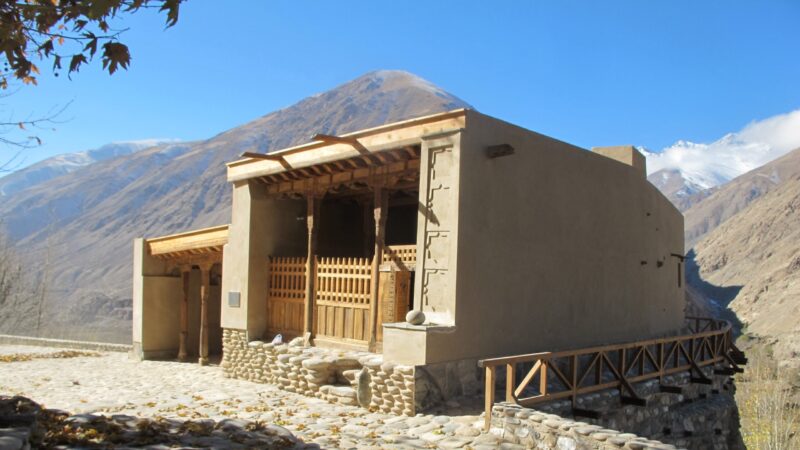
The volume represents one of the earliest independent academic studies of Ismaili communities across Afghanistan, China, Pakistan, and Tajikistan. It brings together contributions from scholars working across disciplines and intellectual traditions. The chapters integrate local and Western perspectives to examine history, culture, traditions, educational practices, philosophical thought, and evolving forms of identity within the Pamir mountain regions. The volume focuses on ethnolinguistic and ethnoreligious relations, as well as on globalisation and migration processes related to minority communities across various geopolitical contexts.
The Pamiris, or Badakhshani as they are commonly called, are a small group of Iranic peoples inhabiting the mountainous Pamir-Hindu Kush region, the historical area of Badakhshan which is spread across four modern nations. This volume examines the identification of several mountain communities whose vibrant, active cultures, ancient languages, and complex political histories continue to influence global geostrategy. Several chapters explore what defines a Pamiri and critically assess the impact of both transregionalism and globalisation on the activation, cohesion, and unification of dispersed communities.
The volume presents various aspects of identity and identification among the Pamiris. It is divided into three parts. The first part covers the region’s geography and the modern history of Pamiri communities. The second part analyses the work of prominent historical figures and explores the rich philosophical, religious, and cultural heritage of the Pamiris. The final section addresses contemporary issues such as the dissemination of traditions, global order, interconnectedness, and what it means to be a Pamiri for the region’s youth. The contributions by expert authors offer fresh perspectives on the region’s Ismaili communities and enrich the historical and ethnographic legacy of the Soviet era with contemporary scholarly research.
Russian edition and readership
The Russian edition is published under the title Идентичность, история и транснациональность в Центральной Азии. Горные сообщества Памира (Moscow: Лингвистика, 2025). Making this research available in Russian broadens access for readers in Central Asia and Russia.
This Russian publication represents a translation of the first comprehensive English-language monograph exclusively focused on the peoples of the Pamirs. It will appeal to specialists in history, anthropology, religious studies, sociology, linguistics, education, and geography related to Central and East Asia, as well as to those interested in Islam, Islamic thought, minority-majority relations, population movements, and the processes involved in defining and affirming minority identities. The volume is also aimed at undergraduate and postgraduate students, as well as university faculty studying high-mountain communities.
The publication aims to sustain intellectual and cultural connections with Ismaili communities in Russia and Tajikistan, while engaging the wider global Ismaili community. By widening linguistic access to this major scholarly study, the volume supports reflection on shared histories, traditions, and beliefs within the context of globalisation and diverse national settings.
Editor of the Russian edition
Leyli R. Dodykhudoeva is the author and editor of several volumes in both Russian and English on Iranian linguistics and literature. She has also translated numerous works in Ismaili studies into Russian. Her primary research interests include Pamir studies, Iranian minority languages, Pamir languages, and ethnolinguistic and linguacultural studies.