The Institute of Ismaili Studies (IIS) presents the virtual launch of Contemporary Trends in Sharia: Critical Debates in Historical Contexts. The book is co-authored by political sociologist Dr Hadi Enayat and English-trained barrister and cross-cultural mediation specialist Dr Mohamed Keshavjee, with a foreword by Dr Christophe Bernasconi, Secretary General of the Hague Conference on Private International Law. In this filmed conversation, both authors discuss the book chapter by chapter, guided by the moderator Dr Fatima Dhanani.
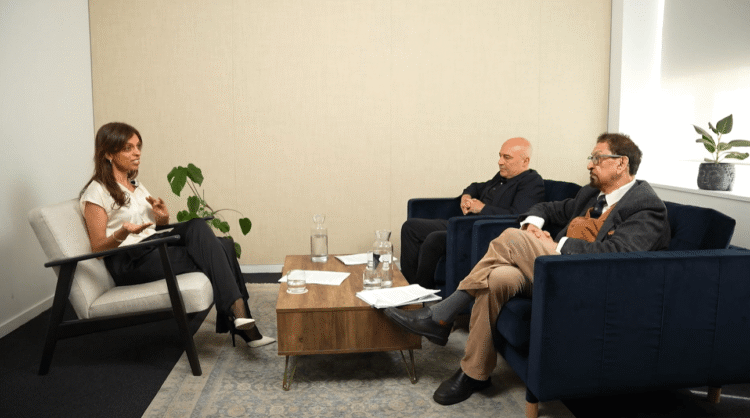
Contemporary Trends in Sharia virtual launch
Most books on shari‘a focus on jurisprudence and legal theory. This book takes a different path, situating shari‘a within its historical, sociological, cultural and political contexts. Across the discussion, Dr Enayat and Dr Keshavjee argue that social justice lies at the heart of law in Islam, and that rigid, static readings run contrary to shari‘a’s own tradition of reasoning. They probe the purpose of law, its limits and contradictions, and its potential to meet the evolving needs of Muslim communities in the twenty-first century.
Key themes
- Why history matters to understanding shariʿa, and the higher purposes of law (maqasid al-shariʿa).
- Constitutionalism in the Islamic tradition, from the Constitution of Medina to modern debates.
- Islamic criminal justice and its restorative ethic, read alongside English common law.
- Secularism and religious freedom across Malaysia, Senegal and Tunisia.
- Gender justice, Muslim women’s scholarship, and the global Musawah movement.
- Property rights, zakat and waqf as instruments of a distributive ethic.
- Dispute resolution, the Ismaili Conciliation and Arbitration Board, and the Hague Convention.
- The limits of law, and the ethical resources that lie beyond it.
The book is published with Bloomsbury and available to read as an open-access publication.