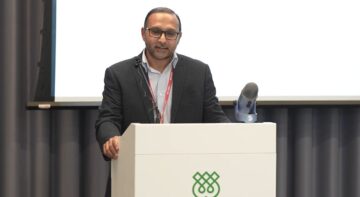
In this video, Dr Wafi Momin, Head of Ismaili Special Collections, introduces ginans and explores their continuing cultural and literary significance.

Dr Wafi Ahmed Momin, Head of Ismaili Special Collections
Ginans are religious, mystical and literary compositions that have been recited for centuries, particularly by Nizari Ismaili communities. Drawing on the languages and cultural traditions of South Asia, their teachings encourage spiritual reflection. Dr Momin explores their themes, languages and musical traditions, as well as their continuing significance for Nizari IsmailisAdherents of a branch of Shi’i Islam that considers Ismail, the eldest son of the Shi’i Imam Jaʿfar al-Ṣādiq (d. 765), as his successor. and other communities.
Resources
Explore these resources to learn more:
- Asani, Ali S. “The Ginān Literature of the Ismailis of Indo-Pakistan: Its Origins, Characteristics, and Themes.” In Diana Eck and Françoise Mallison (eds.), Devotion Divine: Bhakti Traditions from the Regions of India. Groningen/Paris: Egbert Forsten; École Française d’Extrême-Orient, 1991, pp. 1–18.
- Momin, Wafi. “Salvific Visions and the Ginans” Keynote address, Association for the Study of Ginans, 2024.
- Shackle, Christopher, and Zawahir Moir. Ismaili Hymns from South Asia: An Introduction to the Ginans. Revised edition. Richmond, Surrey: Curzon, 2000.
About the series
Questions & Reflections explores Ismaili and Muslim history, faith, doctrine, and practice through IIS scholarship. Each video draws on IIS scholars’ expertise and research to offer a short, scholarly response to a question.
Topics range from Qur’anMuslims believe that the Holy Qur’an contains divine revelations to the Prophet Muhammed received in Mecca and Medina over a period of 23 years in the early 7th century CE. More translations and the Ismaili Imamat to religious authority, cultural traditions, and diverse Muslim practices. The series invites viewers to explore the histories, ideas, and contexts that have shaped Muslim and Ismaili traditions.